Am I The Problem?
a radical feminist and marxist meditation on vanity and commodification of women


At the start of the year (actually about a month in), I finally opened my freshly crafted Louise Carmen Roadbook to start planning for the year. In the processes, I stumbled into making a list of traits I’d like to change and at the top of the list was my vanity.
I had spent too much time and energy over the past couple years pouring over the best topical retinoids to prevent wrinkles in your early 20’s, clothing in colors that will compliment my “season” and styles that flatter my body type, the perfect everyday blush for my makeup bag that won’t make me look like I just got slapped— the list goes on endlessly. Being vain genuinely feels like the antithesis of my entire moral system—a fragmentation of the human person I truly am. How can I — a staunchly Marxist radical feminist — uphold a system that directly betrays these values? When I think about my perception of my appearance and the consumption and commodification that ensues as a result, it feels like a betrayal.
So, as one does (particularly an insufferable woman with a degree in Critical Theory), I dove into articles and journals, even dusting off my Marx—Engels Reader to explore this phenomenon I can only describe as the feminist double consciousness. My first quarter in my freshman year of undergrad, I took my first political theory course and the Marx—Engels Reader was our first assigned text. I couldn’t figure out why Marx’s theory on alienation stood out to me, especially alienation of the self. I remember reading the line “The less you are, the less you express your life, the more you have, the greater is your alienated life and the greater is the saving of your alienated being”. I read his theory of alienation over and over again that year, but was never able to answer why I felt it so deeply until recently.
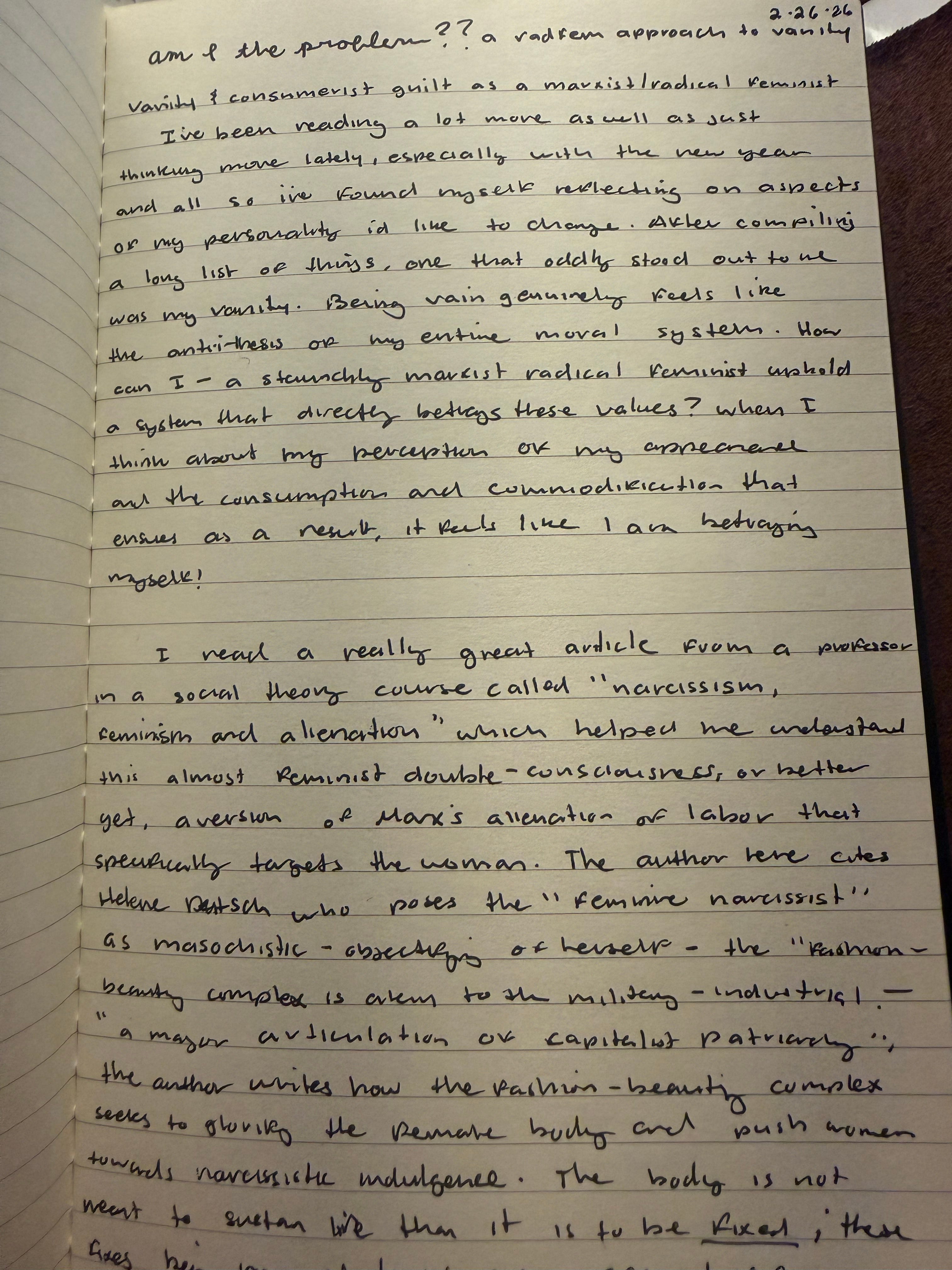
I stumbled upon an article from Sandra Lee Bartky called “Narcissism, Feminism and Alienation” which helped me understand this sort of feminist double-consciousness, or better yet, perversion of Marx’s alienation of labor that specifically targets the woman. Bartky argues that the “fashion-beauty complex” glorifies the female body while pushing women toward narcissistic indulgence. It produces “false needs” through psychological manipulation, creating anxieties about the body that are then answered with products offered as a “sacramental” cure. With this, the body is not meant to sustain life, it is to be fixed or altered, the female body is a task or an object “in need of transformation.” I exist as my body, yet am forced to stand at a distance from it in a “permanent posture of disapproval,” viewing myself through the eyes of what Bartky calls a “cold male connoisseur.” Bartky poses feminine vanity as the internalization of being an object as women take erotic satisfaction in our own “thing-hood” because we see ourselves as subjects, creating a fragmentation of the self where our consciousness is inhabited by internal witnesses who are representatives of a system (capitalist patriarchy) that is hostile to us.
Catharine MacKinnon in “Feminism, Marxism, Method and State” created the bridge that allowed for this framework to start finally making sense to me. She equated sexuality as work, just as Marx argued that society is constructed how people work to survive, feminism shows that society is organized through the way sexuality is molded and expressed. Just as the expropriation of labor defines a worker, the “organized expropriation of the sexuality of some for the use of others defines the sex, women,” making identity for women synonymous with desirability to men. MacKinnon’s perspective on the “choice” to be vain is incredibly comforting as she argues that women’s acceptance of this condition is not a contradiction if we have “little choice but to become persons who freely choose women’s roles”.
With this understanding, I now realize that Marx had described a form of alienation I recognized and felt deeply, even though I couldn’t put a phrase to it. As the worker is alienated from their labor, the woman is alienated from herself. Our bodies, like labor under capitalism, become something to be managed, improved, and ultimately offered up for the consumption of others.
So this takes us back to the original question raised in the title, where does it leave me and other women I know are feeling the same sentiment. I participate in the rituals I claim to critique. I buy the products they sell me, I care how I look and I experience the validations that come with appearing attractive. On paper, I am the problem but framing this as a purely personal contradiction ignores the structure that produces and perpetuates it. Consumer capitalism depends on women feeling as though their bodies are projects. Vanity is profitable because insecurity is profitable, posing feminine vanity as less of a moral failure than a clear outcome of a system that commodifies women and teaches us to internalize that commodification as self-perception. It may feel as though this entire discussion has taken us nowhere, but hopefully it reminds us, as women, that the most successful commodification of women may be the one we learn to perform on ourselves, and being aware of that is resistance enough.
Loved this and love you so so much bro ❤️ reminds me of Kierkegaard in either/or, "the most common form of despair is not being who you are".... so excited for whatever u post here next